
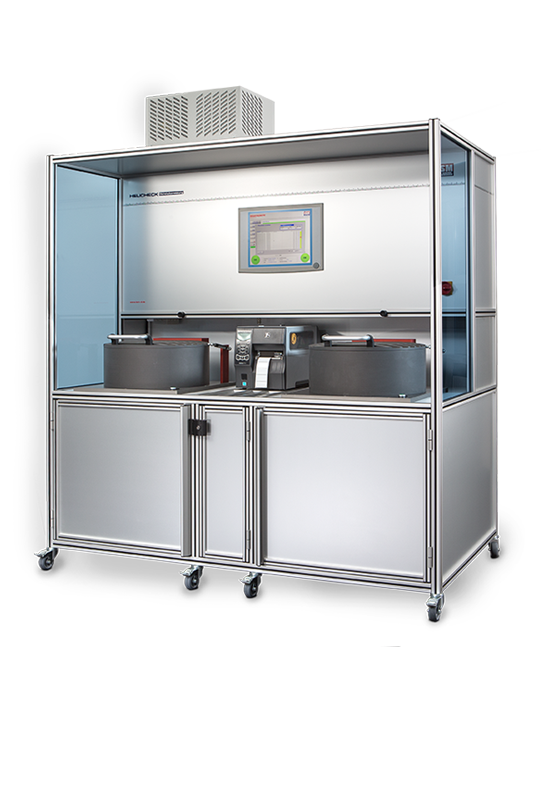
The new DELTACHECK leak-tightness measuring systems enable cost-effective and reliable differential pressure measurement through the use of specially developed and standardised modules:
Test rack
Control equipment and measurement data processing software
The customer-specific adaptation to the test object remains as the only special design and is manufactured in our in-house design and machining department.
The exclusive use of the following high-quality components significantly increases the availability of the testing machine:
Measurement technology: ISM
Pneumatics: Festo
Profile building system: Item
Control equipment: Siemens / Advantech / NI
This configuration consisting of standard modules and custom test item adaption allows us to deliver fast and at favourable prices.
Industry 4.0 ready
Parameter input and process visualization via 17 “touch screen
Test stand control by fanless industrial PC
Measurement data storage
Surveillance of all process-relevant parameters
Manual or automatic closure of the test stand
“Test object in position”-monitoring
Gross leak monitoring
Exchangeable plates for different test specimens (option)
Automatic test object clamping and adapter closure (option)
Operator protection by safety light curtain (SICK)
Quick-change systems with central coding connector (option)
Use of state-of-the-art pneumatic components (FESTO)
Short signal paths by placement of the measuring and vacuum components in the substructure of the test stand
Lockable double wing doors facilitate service
Control cabinet at operator height, rear side
Reserve for upgrading 20 %.
Controller with 16 inputs and outputs
Ethernet, USB, RS232 interfaces as standard
Example I – Differential pressure tightness measurement on fuel manifolds
Max. allowed leak rate: 1 x 10E-2 mbar l/s
Test pressure: 5 bar
Cycle time: 25 s
Example II – Differential pressure tightness measurement on oil suction pipes
Max. allowed leak rate: 5 x 10E-1 mbar l/s
Test pressure: 2,5 mbar
Cycle time: 8 s
Example III – Differential pressure tightness measurement on oil pressure switches
Max. allowed leak rate: 1 x 10E-1 mbar l/s
Test pressure: 8 bar
Cycle time: 7 s
1x Test stand made of Item AL profile system
1x Differential Pressure Leak Detector DP300
1x Control cabinet with process control and data processing hardware, 17″ touch screen IP 65
1x Customer-specific adaptation of the test object
Delivery time 8 weeks
Warranty 12 months
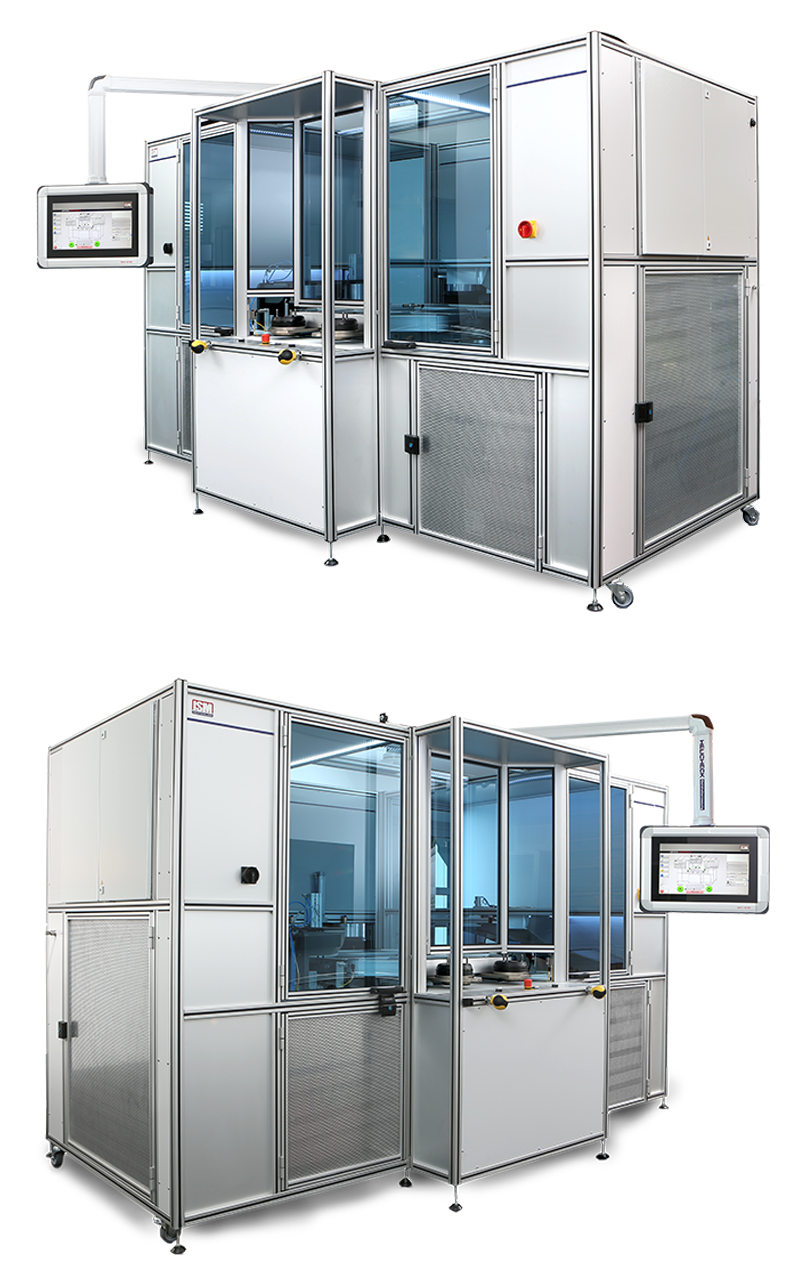
Technical Data
The technical data at a glance
Measuring range DELTACHECK
up to 1x10E-3 mbar l/s depending on specimen volume
Measuring range DP3000
0,01 ... 20,00 mbar l/s
Computer
Fanless Industrial PC, WIN 10
160 GB 24/7 hard disk drive
I/O
16 in-/outputs
10 analog inputs
Interfaces
Ethernet / USB / Rs232
Display
17 "IP65 Touchscreen with front USB interface
Compressed air supply
Pressure transmitters
Test piece in position / coarse leakage measurement
Pressure drop / absolute pressure
Optional
Flow measurement
Power supply
230 V 50/60 Hz
Power consumption
up to 0.8 KW
Pneumatic
Compressed air, dry, clean, oil-free, min. 6 bar
Dimensions
approx. 1100 (W) x 1100 (D) x 2100 (H) mm
Weight
approx. 200 - 250 kg
Show all
Downloads
For further supporting documentation please see below.
Auf dieser Website werden Cookie verwendet. Diese werden für den Betrieb der Website benötigt oder helfen uns dabei, die Website zu verbessern.
Alle Cookies zulassen
Auswahl speichern
Individuelle Einstellungen
Dies ist eine Übersicht aller Cookies, die auf der Website verwendet werden. Sie haben die Möglichkeit, individuelle Cookie-Einstellungen vorzunehmen. Geben Sie einzelnen Cookies oder ganzen Gruppen Ihre Einwilligung. Essentielle Cookies lassen sich nicht deaktivieren.
Speichern
Abbrechen
Essential (1)
Essential cookies are needed for the basic functionality of the website.
PPM / mg/m³ conversion with PID correction factors
PID Response Factors
11.7 eV-
10.6 eV-
10.0 eV-
Excellent detectability, suitable for precise measurements
Detectable, not suitable for precise measurements
Poor detectability, poor measurement output
Suitable Measuring Devices
-
Advanced Settings (Temp/Pressure)
Result---mg/m³
Formula: mg/m³ = (ppm × MW) / Vm
Vm = 24.45 L/mol
User Manual: PID Gas Search
This tool helps with PID detection and gas concentration conversion. Follow this short guide.
1. Search for a gas
Enter the name, molecular formula or CAS number in the search field. The local database returns results instantly; if PubChem is enabled, unknown substances are looked up online.
2. Check PID detection factors
The three values show the response factor for 11.7 eV, 10.6 eV and 10.0 eV lamps. The color coding (green/yellow/red) indicates how well the gas can be detected.
3. Convert concentration
Enter the molecular weight and the measured value. Use the arrow button to switch between PPM → mg/m³ and mg/m³ → PPM. Temperature and pressure can be adjusted under "Advanced Settings".
4. Device recommendation
Based on the PID values and gas properties, suitable measuring devices are suggested. Click on a device name to go to the product page.
Disclaimer: PID Gas Search
The calculations, conversions and results provided in this application ("PID Gas Search") are intended solely for information and orientation purposes. Despite careful development and verification, no warranty is given for the correctness, completeness, timeliness or suitability of the provided content for a specific purpose.
The application does not replace any professional assessment, standard-compliant testing, or documentation required by authorities or experts. In particular, the results do not constitute a binding statement about gas concentration, detectability or the suitability of measuring devices.
Responsibility for interpreting and using the calculated values lies solely with the user. Decisions made on the basis of this application are at the user's own risk.
The operator/developer assumes no liability for material or immaterial damages, directly or indirectly arising from the use or non-use of the provided information, unless caused by intent or gross negligence.
It is the user's responsibility to independently observe and comply with the applicable standards, guidelines, legal regulations and test requirements (e.g. relevant DIN, EN or ISO standards).
By using the application, the user agrees to these terms.
Welcome to the Leak Rate Converter. Below is an overview of the formulas and functions used.
1. Sniffer Leak Testing
Converts various leak rate units (mbar·l/s, scc/s, g/a, oz/yr, ppm) into each other.
PPM formula (depends on suction flow):
PPM = (Leak rate cm³/s / Suction flow cm³/s) × 1,000,000
Mass leak rates (g/a) use the ideal gas law: q = (m_dot × R × T) / M
2. Leak Rate Comparison
Calculates the equivalent leak rate under different pressure or gas conditions for laminar flow (Hagen-Poiseuille).
Formula: Q2 = Q1 × (η1 / η2) × [ (P2_in² - P2_out²) / (P1_in² - P1_out²) ]
3. Parameter Determination
Determines the required test leak rate based on standardized tightness classes (e.g. water-tight). For SF6 systems (0.1 % loss/year):
Q_Ref = (System volume × Fill pressure × 0.001) / 31,536,000 s
4. Differential Pressure
Converts a physical pressure drop into a volumetric leak rate.
Formula: dv/dt = (V / P_atm) × (dp/dt)
Note: For the unit mbar·l/s, atmospheric pressure is not included (pure pV throughput).
Disclaimer – Leak Rate Converter
The calculations, conversions and results provided in this application ("Leak Rate Converter") are intended solely for information and orientation purposes. Despite careful development and verification, no warranty is given for the correctness, completeness, timeliness or suitability of the provided content for a specific purpose.
The application does not replace any professional assessment, standard-compliant testing, or documentation required by authorities or experts. In particular, the results do not constitute a binding statement about the tightness, safety or conformity of components, systems or installations.
Responsibility for interpreting and using the calculated values lies solely with the user. Decisions made on the basis of this application are at the user's own risk.
The operator/developer assumes no liability for material or immaterial damages, directly or indirectly arising from the use or non-use of the provided information, unless caused by intent or gross negligence.
It is the user's responsibility to independently observe and comply with the applicable standards, guidelines, legal regulations and test requirements (e.g. relevant DIN, EN or ISO standards).
By using the application, the user agrees to these terms.